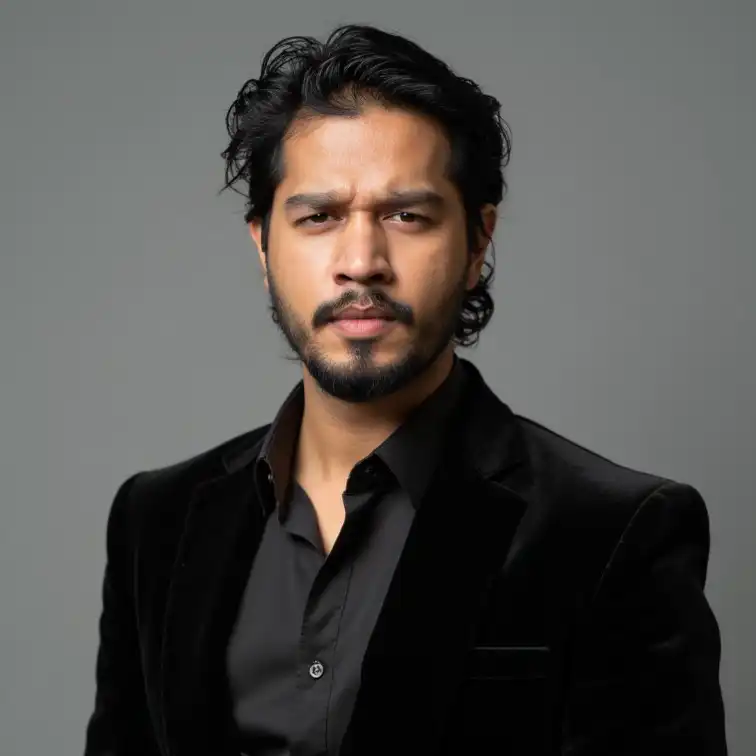
From Delhi Rock Bands to a Solo Hindi Music Catalog
I played the Delhi rock band circuit from 2009 to 2013, then went solo as ABHI. Here is what carried into the Hindi catalog and what I left on the stage.
Before the solo Hindi catalog, there were Delhi rock bands. Between 2009 and 2013 I played the Delhi and NCR live circuit in a run of them, working the pub and college-festival scene that carried Indian indie rock at the time. In 2013 I stepped off that stage and started releasing original songs on my own, under the name ABHI. This is the honest origin account: what the band years actually were, what the live circuit taught, and what crossed over into the 50+ track catalog that followed.
TL;DR
- I played the Delhi and NCR rock circuit from 2009 to 2013, across multiple bands, before going solo.
- The band-era sound was pop rock, heavy rock, metal, and alternative rock, tracked in Audacity then FL Studio, and most of it stayed unreleased demos.
- Going solo as ABHI in 2013 was the point where the work started actually shipping and being owned end to end.
- A guitar-driven, song-first backbone, the loud-drummer test for songs, and a stage-tested vocal instinct all carried into the Hindi and Urdu catalog.
- What got left on the stage: the volume, the band dependency, and a hard drive of demos that never became masters.
The Delhi rock circuit, 2009 to 2013
Delhi has always produced musicians faster than it could find rooms to host them. By the late 1990s the independent scene had clustered around a few anchors, and the closest thing to an aspirational stage was Turquoise Cottage in Adhchini, near IIT Delhi, which had a real sound system and, more importantly, an audience that came to listen. In 2007 it was sealed shut in a Supreme Court-directed crackdown on South Delhi establishments that broke zoning rules, and the energy did not survive the move to a mall. For a window that lines up almost exactly with my band years, Hauz Khas Village filled the gap: between 2008 and 2013 a cluster of ad hoc rooms gave the neighbourhood the density of a genuine music district, as Homegrown's history of the city's independent venues documents in detail.
The infrastructure under all of it was older than the venues. Rock Street Journal, started in 1993 by Amit Saigal, spent years sponsoring college fests, coaxing pubs into hosting bands on set nights, and running its own festival, the Great Indian Rock, the first multi-city rock festival in the country. That is the ecosystem I came up in: college competitions, pub nights, and a circuit that mostly paid in exposure. It was the real working apprenticeship. You learn how to arrange for a full band, how to hold a room that did not come to see you, how to mix a monitor on stage while you sing, and how to write a song that survives contact with a loud drummer. Nothing about that is romantic. All of it is useful.
What the band years actually sounded like
If you assume the origin was quiet Hindi ballads, you have the wrong picture. Between roughly 2010 and 2014 what I was writing and tracking was pop rock, heavy rock, metal, and alternative rock. Loud, often, and band-shaped by default. I studied records the way other people studied textbooks in the cassette and CD era of 1990s India, and two sat above the rest for how they were built: Nirvana's Nevermind and Radiohead's OK Computer. The Nirvana influence is also why my main vocal mic through that whole stretch was a Shure SM58, a stage-tested rock mic that handles a screaming vocal without complaint.
The tooling was primitive and it did not matter. I started in Audacity in 2010, learning what tracking even was, then moved to FL Studio around 2011, which turned into one of the two most productive eras I have ever had. Most of what came out of it never shipped. A lot of that window is rough demo jam recordings that never got finished into a master, sitting on a drive. I have written about the full tool arc in the DAW switch I still regret, so I will not relitigate the software here. The short version: the DAW never made the song, and the band years proved it early.
Why I went solo as ABHI in 2013
The real reason was about ownership, and it is worth stating plainly. By the back end of that 2009 to 2013 run I was already composing and producing the songs end to end, then splitting the credit with players who had come in on bass or drums. The band members were also, reasonably, pulling in different life directions: further study, a proper job, plans that had nothing to do with holding a group together. At some point the math stopped working. If I was writing and producing a song from the first idea to the final mix, the drama and the scheduling around everyone else's timelines was a tax I did not need to keep paying. So in 2013 I settled into PreSonus Studio One, put the first uploads out on YouTube under the name ABHI, and ran the pipeline end to end. Self-owned is not the same as solitary: I brought in session musicians and vocalists when a part actually called for one, on my schedule, and kept quality control from first idea to final mix. What changed was that the decision to finish and release, and the credit for the song, was mine.
The other thing 2013 changed was ownership of the catalog itself. A band splits songs, splits rights, splits the decision to put something out. A solo catalog under one name compounds. Every track I released from that point forward was mine to license, to give away free, or to hold. That single structural choice is what a decade of catalog rests on, and it is the same instinct I now apply to running a lean team and a self-owned stack: own the thing end to end, keep the core small, ship.
What carried into the Hindi catalog
The clearest inheritance is the sound. The guitar-driven, song-first core that runs through the Hindi and Urdu catalog is a direct trace of those years, not a costume put on later. The genre softened on a slow arc, into soft rock and rock ballads across the mid-2010s, then folded in electronic percussion and synths from 2020 on, but the guitar-and-song backbone never got replaced. You can hear it across the range. Dhund is pure acoustic folk, carried by acoustic guitars and voice. Even a later, electronic-led track like Deewanapan Hai still gets guitar and piano layered into it.
The other inheritance is a test I still use. Call it the loud-drummer test: if a song does not survive being played through a live band with a loud drummer, the writing is not done. It is a stage-born filter that quietly improves a bedroom recording. The bridge track between the two eras is the debut English-language single You Won't See Me Anymore, written back in 2010. Like a lot of that early material it lived first as a rough demo passed between friends over Bluetooth, years before it was formally recorded and released, which is the real texture of the era. It is now the most-watched release in the catalog, past 10 million views on YouTube, and its lyricism and restraint set a voice the catalog has kept ever since.
What I left on the stage: the sheer volume, the band dependency, and most of those demos. The metal and heavy-rock experiments stayed on the drive. That is not a loss. A body of unreleased work is where the technique gets built, and the finished catalog is thinner and better for what did not make it out.
The stage still runs under the songs
The catalog people know starts to crystallize in 2015. The album Aaj Bhi compiles material written across a long runway, with a few core compositions reaching back to 2008 and 2009, squarely inside the band years. The same year brought producing Echoes at Taj and a Grammy submission, both of which sit downstream of everything the circuit taught. Put together, the 2015 releases are the clearest single-year snapshot of a musician who had just finished serving an apprenticeship on stage.
The point of telling the origin plainly is that none of it was a clean break. I did not leave the bands and become a different artist. I took what a loud, unglamorous live circuit drilled into me between 2009 and 2013 and pointed it at a catalog I could own outright. The full arc across all three of my disciplines is on the about page, but the music half of it starts here, on a Delhi stage, in front of an audience that did not come to see me yet.