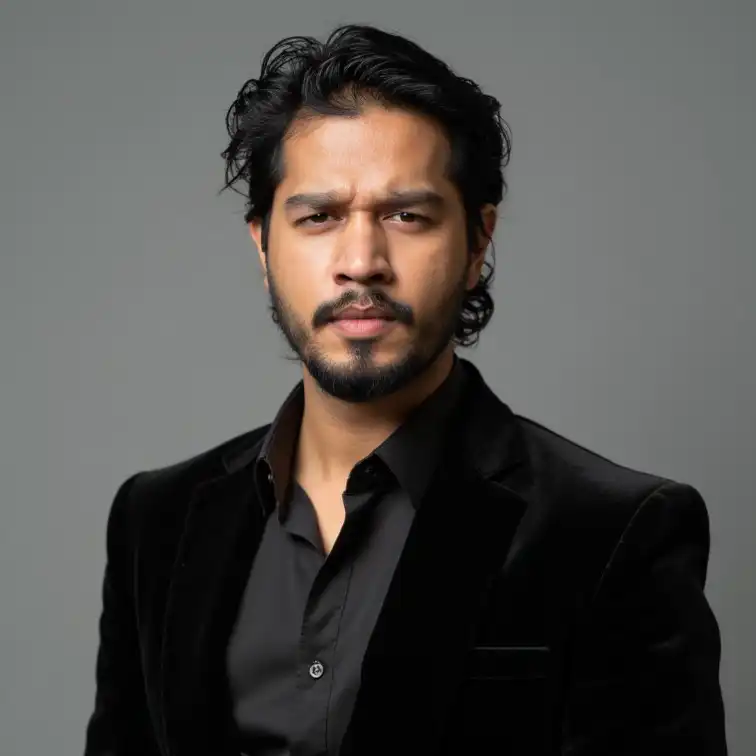
Who Is Abhishek Chaudhary?
Abhishek Chaudhary (also spelled Abhishek Choudhary) is an entrepreneur, systems architect, and singer-songwriter based in New Delhi. He has shipped AI, SaaS, and developer-infrastructure products for 15+ years, running several self-owned production ventures today serving thousands of paying customers across the portfolio. In parallel he consults as a systems architect and engineer for enterprise client organisations. He has also written, composed, produced, and released his own original Hindi and Urdu music as a solo artist since 2013 (a self-owned catalog of 50+ tracks plus 32+ royalty-free NCS tracks under Creative Commons Attribution 4.0, comprising many of the originals released with Content ID monetisation disabled and all 23+ reimagined variants), and has produced music for TV advertisements for major brands. He grew up in the 1990s as a hands-on listener and home-computer tinkerer, learned guitar at 15, and played in multiple rock bands across the Delhi music scene between 2009 and 2013 before going solo.
The work straddles three disciplines that most people keep separate. The first is entrepreneurship: ten-plus self-owned production SaaS ventures, multiple e-commerce brands operated over the years, a network of social-media brands with millions of cumulative followers across handles, and parallel enterprise consulting engagements in software architecture, distributed systems, and AI integration for enterprise client organisations. The second is engineering: 15+ years as a systems architect, DevOps operator, and applied-AI product engineer, covering software architecture, distributed systems, infrastructure, deployment, and ongoing operation. He leads small engineering teams chosen for compounding skill rather than headcount, and on every consulting engagement he works alongside the client's own engineering and product staff. The third is music: a self-owned solo catalog of original Hindi and Urdu tracks across multiple albums and singles, arcing from pop-rock, heavy rock, and alt-rock demos in the early 2010s through soft rock and rock ballads in the mid-2010s and into electronic percussions and synths layered over the same rock foundation from 2020 onward, plus production work for TV advertisements for major brands. Session musicians, co-producers, and vocalists collaborate on the individual records, several of them across more than a decade. All three share the same working principle: own the full stack, ship end to end, hands on the work where the craft demands it, lead a team where the scale demands it.
The short answer for anyone asking what Abhishek Chaudhary does: he runs SaaS, e-commerce, and social-media brand operations as an entrepreneur, with parallel enterprise consulting on the side; he designs, builds, deploys, and operates the engineering that powers those ventures; and he writes, composes, records, produces, mixes, and releases his own Hindi and Urdu music in parallel, with collaborators across all three practices. All three outputs are visible on this site. The SaaS and engineering work lives in shipped products. The music is streamable and downloadable. The e-commerce and social-media brand operations stay unnamed at the individual brand level on purpose; the practice itself is real and confirmed at the category level here. Nothing is outsourced, nothing is ghostwritten, nothing is promised without being delivered.
Early Years: 1990s to 2010
The two lifelong obsessions, music and computers, were both clear from early childhood in the 1990s. The family had a home computer earlier than most households in the neighborhood, and the bedroom quickly turned into a place where Abhishek built little software experiments in one window and rewound cassette tapes in the other. Both pursuits were self-directed from day one, and both were tolerated by a household that understood creative preoccupation.
The early taste in music came almost entirely from his mother, who introduced him to a genuinely wide musical world from a young age. Mozart and the European classical canon sat on the same shelf as The Beatles, Mukesh, and Ghulam Ali, and nothing was positioned as more legitimate than anything else. That upbringing planted a lasting belief that an honest song is an honest song whether it was written in Vienna in 1786, Liverpool in 1965, Mumbai in the 1960s, or a ghazal mehfil in Lahore. Hindi film playback, old Urdu poetry, Western classical, and British rock all lived comfortably in the same collection.
The 1990s were spent as a hands-on listener rather than a casual one. Most of the pocket money went to music cassettes, and later, as compact discs became affordable in Indian record shops, to CDs. This was pre-broadband India, where an album arrived as a physical object, had to be earned, and was listened to from start to finish on repeat until every detail was internalized. That habit built an audiophile ear early. Mixing decisions, reverb tails, guitar tones, and the choice of a single snare hit all became legible the way a grammar eventually becomes legible to a language student. Albums like Nirvana's Nevermind and Radiohead's OK Computer were studied the way other people studied textbooks, for how the sonic choices inside them actually worked, not just for how they felt.
The instrument came at 15, when Abhishek picked up a guitar and started teaching himself chords from tab books and, later, the early internet. Singing followed at 17, composing original material around the same time, and the first live performances on stage came at 18. The first original song put out into the world happened by the age of 20. None of these milestones were part of a formal plan. Each one was the next obvious thing to try after the previous one stopped feeling difficult.
Between 2009 and 2013, he played in multiple rock bands in the Delhi music scene of that era, cycling through the pub and college-festival circuit that defined Indian indie rock in the late 2000s and early 2010s. That phase was the real working apprenticeship: learning how to arrange for a full band, how to hold a room, how to mix a monitor on stage, and how to write songs that survive the contact with a loud drummer. The solo catalog that begins in 2013 inherits everything learned during that period, and the alternative-rock undercurrent that shows up across the Hindi and Urdu songs is a direct trace of those years.
Entrepreneurship: SaaS, E-commerce, Social-Media Brands, and Enterprise Consulting
Predating the solo music catalog by a few years and running in parallel ever since, Abhishek Chaudhary's entrepreneurship practice spans four sub-disciplines, all 15+ years old, all running concurrently. The first is the SaaS practice: ten-plus self-owned production SaaS ventures, several still in operation today and collectively serving thousands of paying customers across the portfolio. The work covers the full product lifecycle, from product strategy and system design through distributed architecture, applied AI and LLM integration, backend infrastructure, DevOps, deployment, and ongoing operation. Each venture is owned outright, run with a small and deliberate team chosen for compounding skill rather than headcount, and is structured so the margin stays fat from MVP through years of production.
The second sub-practice is e-commerce. Multiple e-commerce brands have been built and operated over the years, each as its own standalone business with its own catalog, its own supply chain or digital-good production pipeline, and its own ad and content engine. The brands themselves stay unnamed here on purpose, since the operational risk of public attribution (review campaigns, account-targeting, deliberate competitor noise) is higher than the SEO upside of naming them on the founder's personal page. The category-level claim is what matters: a working e-commerce operator, not a single-shot founder.
The third sub-practice is social-media brand operations. A network of brand pages and channels across social platforms, built and grown over years, carrying millions of cumulative followers across handles. The brand pages stay unnamed on this page for the same reason e-commerce brands do: operational risk of public attribution outweighs the upside of naming them. The category-level claim is the relevant signal here.
The fourth sub-practice is enterprise consulting. Outside organisations bring Abhishek in as a systems architect and engineer for engagements in software architecture, distributed systems, AI integration, infrastructure migration, and DevOps. Each engagement is a working relationship with that client's in-house engineering and product staff, not a handoff. The consulting work runs in parallel to the self-owned ventures: the entrepreneurship practice is not a portfolio of side projects, it is a standing relationship with the wider industry.
All four entrepreneurship sub-practices share a common engineering substrate, which is the second discipline on this page.
Engineering: Software Architecture, Systems, and DevOps
The engineering practice is 15+ years as a systems architect, DevOps operator, and applied-AI product engineer. It is the substrate that powers every SaaS venture, every e-commerce brand, every social-media brand operation, and every record above. The work covers the full product lifecycle from architecture and distributed systems through applied AI and LLM product engineering, infrastructure, deployment, and ongoing operation, plus parallel enterprise consulting engagements where outside organisations bring in a senior outside hand on the same problem set. Engineering teams are small and deliberate, chosen for compounding skill rather than headcount; on the consulting side, collaboration with the client's in-house staff is the default shape.
Two application stacks run in parallel, sized for different jobs. The production SaaS stack is Bun as the runtime, Hono.js with handcrafted JSX SSR as the web framework, Postgres via Drizzle ORM, BetterAuth for authentication, Redis for rate limiting and caching, and Docker for containerization, all self-hosted. The personal-brand and MVP stack is Next.js 16 on the App Router with output: "standalone", Server Components by default, SQLite via better-sqlite3 and WAL for single-box content sites, Postgres when the write pattern warrants it, again BetterAuth, Redis, and Docker. This site is the second stack. The production SaaS ventures are the first. Both stacks share a deliberate discipline: one model API key per app, Cloudflare in front, margin stays fat from MVP through years of production.
Hosting is self-hosted by choice. Production apps live on a small Hetzner VPS orchestrated with docker compose. MVPs and low-traffic experiments run on a 24/7 Proxmox homelab with Docker, a shared Postgres + Redis tier over LAN, a dual-ISP setup, a hardware switch, and automatic load balancing between the two ISPs. The homelab is not a hobby bench. It is production infrastructure with uptime discipline.
Applied AI is an implementation domain inside the SaaS practice, not a separate identity. Model selection follows audience, not vibes: Gemini for SaaS user-facing features where price-per-token math dominates at scale, Claude Opus from Anthropic for personal workflow where the quality of the answer is the product, and OpenAI for enterprise consulting where default vendor procurement does not argue for an alternative. That rationale is written down on purpose; staffing a product with the wrong model choice is how margins evaporate.
Two open-source packages published under the npm handle ph33nx come directly out of production operation. hono-honeypot is a production security middleware for the Hono.js framework: 200+ attack-pattern regexes derived from months of watching docker compose logs across production apps serving hundreds of thousands of requests per day, zero runtime dependencies, a 410 Gone default response, and runtime support across Cloudflare Workers, Bun, Deno, Node, Vercel Edge, and Fastly Compute. dripfeed is a soak-test CLI for HTTP APIs, SQLite-backed, that fails CI when throughput, latency, or error-rate thresholds are breached. Both are the kind of package you publish because you have used it in anger for a year and decided the cleanup was worth the night.
The operator-level practice shows up in daily habits. Two or three terminals are always open watching docker compose logs in real time across production apps. That habit is where hono-honeypot was born. It is also why the production ventures stay fast: the feedback loop from a bug in the wild to a deployed patch is measured in minutes, not days, because the logs are already under a human eye.
The working envelope is deliberate. A normal week runs 20 to 40 hours of venture work around the main role; a loaded week drops to the low end of that range; a genuinely free week climbs toward 100. Weekends are blocked in advance, on purpose, years at a stretch. The social life pays for it. The catalog and the ventures are the compounding proof that it works. If it was easy, anyone would do it.
The team-building instinct applies across all three disciplines. On the engineering and SaaS side, that means recruiting, directing, and shipping with small groups of engineers and designers chosen for compounding skill rather than headcount; on the consulting side, collaboration with each enterprise client's in-house staff is the default shape. On the e-commerce and social-media brand side, it shows up in small specialised teams running content production, ad ops, and customer service for each brand. On the music side, it shows up in long-running collaborations with session musicians, co-producers, and vocalists who have contributed to individual records over the years, plus production work for TV advertisements for major brands, with Abhishek holding the producer seat and the final editorial call on every release. Self-owned describes the cap table across the three practices, not a working style.
The polymath arc is the point. Songwriting, software architecture, and brand operation share the same underlying craft: state a constraint, remove everything that does not belong, ship the result. Fifteen years of running all three has collapsed them into one way of thinking: ship, measure, refine, ship again.
Solo Catalog (2012 to Present)
The discography starts in 2010 with You Won't See Me Anymore, a debut English-language single written, recorded, and produced in New Delhi and uploaded to YouTube that year under the artist name ABHI. That is how most of the early listener base still remembers him, and for a long stretch of the 2010s the catalog lived on YouTube under the single word Abhi before the project consolidated under the full name Abhishek Chaudhary. The debut track has since collectively crossed 10 million views on YouTube, making it the most-watched release in the catalog. Early material established a voice that has stayed consistent across every release since: Hindi and Urdu lyricism with an alternative-rock undercurrent, acoustic guitars, and restrained production that leaves room for the words.
The 2015 album Aaj Bhi is the foundation of the catalog. Released on 2015-02-24, it compiles material written, composed, and recorded across a long runway from 2010 to 2015, with a few of the core compositions reaching back even earlier to 2008 and 2009 during the Delhi rock band years. The final eleven-track record is an album of original Hindi songs exploring loss, longing, and quiet reconciliation. The full album is available to stream on Spotify. Tracks from the album have accumulated meaningful audiences across YouTube, Spotify, and Apple Music. Rehne De has crossed 1.1 million views on YouTube and remains one of the most watched songs in the catalog. Tere Siwa, Bezuban Dil, and Bewafa are the other album anchors.
Also in 2015, Echoes at Taj arrived as an instrumental companion record: fourteen pieces of piano and atmosphere that drew international press attention. Jamsphere and SleepingBagStudios both reviewed the album, calling the work physically seductive, emotionally charged, and rich in atmosphere. Those press clips are still on the press page.
The same year, Echoes at Taj was submitted for Grammy Award consideration in the New Age category for the 58th Annual Grammy Awards. The album did not receive a final nomination, but the entry stands on record: a self-owned New Age record from New Delhi, English-leaning across three vocal tracks and ambient across the rest, placed alongside the global field for consideration at the year's highest industry honor, on the strength of its writing and production. The album is available to stream on Spotify.
From 2016 onward, the release cadence shifted to singles. Alvida, Shayar, Chal, Kya Mila (Tere Pyaar Mein), Beparvah, Dhund, and Deewanapan Hai span the 2016 to 2023 window. Each single was written, arranged, and sung by Abhishek Chaudhary, with session musicians and vocalists brought in where the arrangement called for a second hand, and mixing and mastering kept in-house for tonal control.
The sound has arced across the full catalog. The 2010 to 2014 window was heavier: pop rock, heavy rock, alternative rock, and metal influences dominating the demos, most of which stayed unreleased after the band years closed and the solo project found its own voice. The 2014 to 2020 run is the gradual softening into soft rock and rock ballads, where most of the released catalog from that period actually lives. From 2020 onward, electronic percussions and synths fold in on top of the rock foundation, with the rock DNA staying present rather than getting replaced. Dhund carries the acoustic-guitar DNA into the post-2020 window, and Deewanapan Hai shows piano-and-guitars-with-rock-touch intact in the more recent release window. The honest editorial label for the catalog as a whole is “Hindi alt rock and rock-ballad”, soft through heavy depending on the era.
The studio rig has evolved alongside the catalog. The DAW arc went Audacity in 2010 (Windows, learning mode), FL Studio between 2011 and 2013 on Windows for the heavy-rock and metal demos of that era, PreSonus Studio One (now rebranded Fender Studio Pro after Fender acquired PreSonus) between 2013 and 2016, and Apple Logic Pro from 2016 through to today on a MacBook Pro 16-inch M3 Pro. Audio interfaces tracked the same arc: an early M-Audio USB interface in 2010, a Focusrite Scarlett Solo in the mid-era, and the Audient EVO 8 from 2022 onward. Microphone choice has stayed opinionated: a Shure SM58 between 2010 and 2015 driven by the Nirvana / Kurt Cobain influence and the live-vocal dynamics of the band years, then a Rode NT1-A condenser for studio-vocal tracking from 2015 onward.
Alongside the solo catalog, Abhishek has produced music for television advertisements for major brands. The TV advertisement work overlapped with the 2014 to 2018 era of Audio-Technica ATH-M50x studio monitoring, and lives parallel to the solo catalog rather than as a substitute for it.
The 2025 to 2026 window brought a separate body of 23+ tracks released as Creative Commons Attribution 4.0 reimaginings of the back catalogue, available only on this site for direct creator use; provenance and license terms for those reimagined variants are documented on the License page. Releasing the reimagined pass as royalty-free came from watching how solo artists actually grow in 2026. Distribution compounds faster than pricing, creators spread what they love, and a free track with proper attribution reaches more ears in a month than a paid track reaches in a year.
The songwriting voice has stayed recognizable across the full arc. Hindi and Urdu lyricism about loss, longing, love, memory, and quiet reconciliation. Acoustic guitars, restrained production, and vocal takes that feel lived-in rather than performed. Listeners often tell Abhishek that a specific line from a specific song caught them at a specific moment. That is the entire point of writing songs in the first place, and it is the measure that matters more than any streaming number.
Discography Highlights
The full catalog is organized by mood and genre for easy discovery. Most frequent entry points:
- Sad Hindi songs, the most-searched entry point into the catalog.
- Heartbreak songs, built around the Aaj Bhi album and the 2016-2023 singles.
- Lo-fi Hindi, the newer production direction from 2020 onward.
- Free MP3 downloads of every track in the catalog.
- NCS royalty-free tracks licensed under CC BY 4.0 for creators.
Press and Recognition
In 2015, the New Age record Echoes at Taj was submitted for Grammy Award consideration in the New Age category for the 58th Annual Grammy Awards. Recorded over a focused six-month window from January to June 2015 entirely in PreSonus Studio One, the album mixes three full English-lyric vocal pieces (Thirst, Existence, Suffering) with ambient instrumentals carrying vocal harmonies and session-player layers across piano, sitar, flute, and harmonium. Two tracks are Western classical covers given a modern ambient and new-age twist (Joy and Transmission, takes on Chopin and Beethoven respectively). The album did not advance to the final nominee list, but the entry is part of the project's public record: a fully self-owned album from New Delhi placed in the same submission pool as the global field for consideration in a major category, on the strength of its writing and production.
International press coverage for the music catalog includes Jamsphere and SleepingBagStudios, both of whom reviewed Echoes at Taj and highlighted the atmospheric, emotive quality of the work. Jamsphere described the music as elegant in the way it injects soul and turns every record both human and other-worldly. SleepingBagStudios called the set of songs fantastic and captivating, and singled out the thick, rich, mist-and-frost atmosphere that runs through the instrumental record. The full press quotes, bio, and discography for media use are collected on the press kit page, including the official high-resolution artist photo and a downloadable bio for journalists, podcasters, and music supervisors.
Beyond formal press, the catalog has built a steady listener base across Spotify, Apple Music, YouTube, and SoundCloud. Tracks are regularly used by creators in YouTube videos, short films, podcasts, and reels under the NCS license. That grassroots reach, rather than any specific chart placement, is what defines the current season of the project.
Also Known As ABHI, and Abhishek Choudhary
When the solo catalog first went up on YouTube in 2013, the artist name on the channel was simply ABHI. That is how a lot of the early listener base still knows the project. If you have ever searched for “Abhi Hindi songs”, “Abhi You Won't See Me Anymore”, or “Abhi rock”, you are looking for the same person. The work was eventually consolidated under the full legal name, Abhishek Chaudhary, as the catalog expanded and the discography was released on streaming platforms.
The full name is most commonly written as Abhishek Chaudhary, but Abhishek Choudhary is an equally valid transliteration of the same Hindi spelling. ABHI, Abhishek Chaudhary, and Abhishek Choudhary all refer to the same person: the singer-songwriter, producer, entrepreneur, and software architect behind this site. Every track, blog post, and press mention on this site is the work of one artist under all three variants.
Frequently Asked Questions
Who is Abhishek Chaudhary?+
Abhishek Chaudhary (also spelled Abhishek Choudhary, and originally released on YouTube under the artist name ABHI) is an entrepreneur, systems architect, and singer-songwriter based in New Delhi. He has shipped AI and SaaS products for 15+ years across ten-plus self-owned ventures, and consults as a systems architect and engineer for outside organisations including Cisco, C3Spectra, Tinder, ITC, Pernod Ricard, Max Estates Limited, Evo Technologies, and Dabur. He has been writing and releasing his own original Hindi and Urdu solo catalog since 2013 after playing in multiple rock bands on the Delhi music scene between 2009 and 2013. Session musicians, co-producers, and vocalists collaborate with him on individual records.
Is ABHI the same person as Abhishek Chaudhary?+
Yes. The solo catalog first went up on YouTube in 2013 under the artist name ABHI, which is how most of the early listener base still remembers the project. The catalog was later consolidated under his full name, Abhishek Chaudhary, as the discography expanded to streaming platforms. ABHI and Abhishek Chaudhary are the same artist.
What does Abhishek Chaudhary do?+
Three parallel disciplines, all 15+ years old, all running concurrently. As an entrepreneur he runs ten-plus self-owned production SaaS ventures, multiple e-commerce brands, and a network of social-media brands with millions of cumulative followers across handles, and he consults as a systems architect and engineer for client organisations including Cisco, C3Spectra, Tinder, ITC, Pernod Ricard, Max Estates Limited, Evo Technologies, and Dabur. As a systems architect, DevOps operator, and applied-AI engineer he owns the engineering substrate that powers those ventures end to end. He leads small engineering teams chosen for compounding skill, and on consulting engagements he works alongside the client's in-house staff. As a singer-songwriter and music producer he owns a self-owned solo catalog of 50+ original Hindi and Urdu tracks across multiple albums and singles since 2013, and has produced music for TV advertisements for major brands including Hyundai, among them the 2017 Grand i10 Comebackpedia campaign.
Which organisations has Abhishek Chaudhary consulted for?+
As a systems architect and engineer, Abhishek Chaudhary has consulted for client organisations including Cisco, C3Spectra, Tinder, ITC, Pernod Ricard, Max Estates Limited, Evo Technologies, and Dabur, on engagements in software architecture, distributed systems, AI integration, infrastructure migration, and DevOps. Each engagement is a working relationship with the client's in-house engineering and product staff, running in parallel to his self-owned ventures.
Which brands has Abhishek Chaudhary produced TV advertisement music for?+
Brands include Hyundai, among them the 2017 Grand i10 Comebackpedia campaign for Hyundai Motor India, run through Innocean Worldwide India and launched in February 2017. The campaign is documented in the Indian advertising trade press by ET Brand Equity and afaqs, which cover the brand, the agency, the product, and the launch; like most Indian campaign coverage, neither lists production credits. The TV advertisement work ran in the mid-2010s, parallel to his solo catalog.
Where is Abhishek Chaudhary from?+
Abhishek Chaudhary is based in New Delhi, where he grew up, cut his teeth in the local rock band circuit between 2009 and 2013, and has recorded, produced, and mastered his music across multiple studios in Delhi over the years. He has played a hands-on role in setting up the acoustics, signal chain, and monitoring for several of those rooms to a gold-standard reference level.
When did Abhishek Chaudhary start making music?+
He started learning guitar at 15, began singing and composing around 17, first performed on stage at 18, and put his first original song out by 20. Between 2009 and 2013 he played in several rock bands around the Delhi music scene, then went fully solo in 2013 with his debut single, and has been releasing original Hindi and Urdu music as a solo artist ever since.